
A Modern Icon Before Its Time
The Basket Club Chair by Nanna Ditzel


Designed in the early 1950s, it appeared at a moment when Danish design was becoming known for clarity, restraint, and careful craftsmanship. Ditzel worked within that world, but she also moved slightly beyond it. She was drawn to lighter forms, open structures, and materials that felt close to the hand. The Basket Chair shows this clearly. It is built from bent rosewood and handwoven cane, yet it never feels heavy. The frame lifts the seat like a branch holding a nest, and the cane allows light to pass through in a soft, shifting pattern.
What distinguishes the original rosewood and cane version is its quiet individuality. Nothing is overly perfected; the cane has its natural variations, the weave its slight irregularities. These details give the chair a gentle presence that industrial versions cannot fully capture. The later outdoor interpretations, including the recent production by Kettal, echo the shape but inevitably lose the subtle unevenness and warmth that come from handwoven cane and long-aged wood. The originals carry the marks of the people who made them.

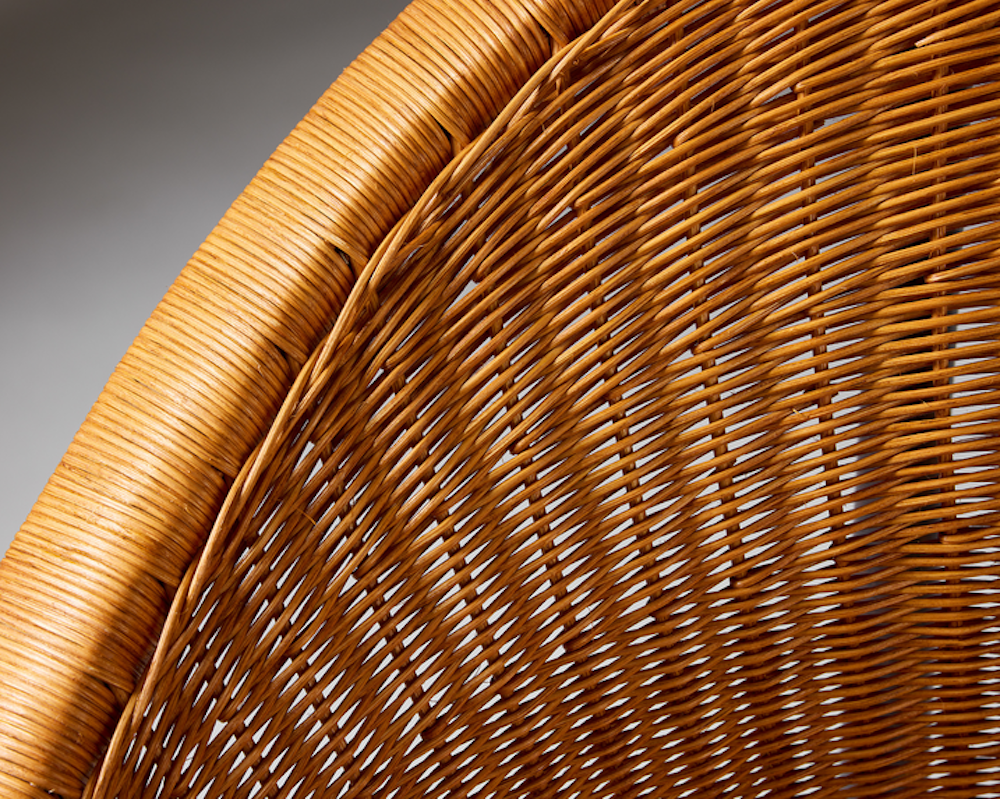
The chair’s proportions also reveal Ditzel’s sensitivity to how a seat should hold the body. The curve of the shell supports without enclosing. The open sides keep the form light, making the sitter feel part of the surrounding space rather than tucked away from it. There is a sense of ease in the design, as if functionality and comfort simply arrived at the same place without effort.
Designed together with her husband, Jørgen Ditzel, the chair reflects a partnership that valued experiment as much as tradition. Both were interested in how craft could coexist with new ideas about living. Their collaboration with skilled cabinetmakers resulted in pieces that sit somewhere between furniture and small-scale architecture. You can see this in the Basket Chair: the way the frame lifts, the way the weave stretches across its surface, the way the chair seems to hold both strength and softness at once.

The Basket Club Chair was never produced in large numbers, and perhaps that helps explain its lasting appeal. It feels personal, not anonymous. It carries a sense of care. Even today, the design feels unusually fresh. Its openness suits contemporary interiors; its materials bring a natural calm into a room; its form sits easily among both older and newer pieces. It doesn’t ask for attention, yet it quietly earns it.
To encounter an original example is to meet a piece of mid-century design that still speaks clearly. Not through grand statements, but through the simple fact that every part of it has been considered. The rosewood warms in the light. The cane softens the shadows. The shape feels balanced without being strict.

The Basket Club Chair stands as one of Nanna Ditzel’s most thoughtful works—a chair that was, in many ways, ahead of its time. It remains a reminder that good design does not need to insist on its importance. Sometimes it is enough for a chair to be honest in its materials, clear in its intention, and quietly confident in its form.
2025-11-19